Hard water
Dissolved limestone carried out and re-deposited as tufa.
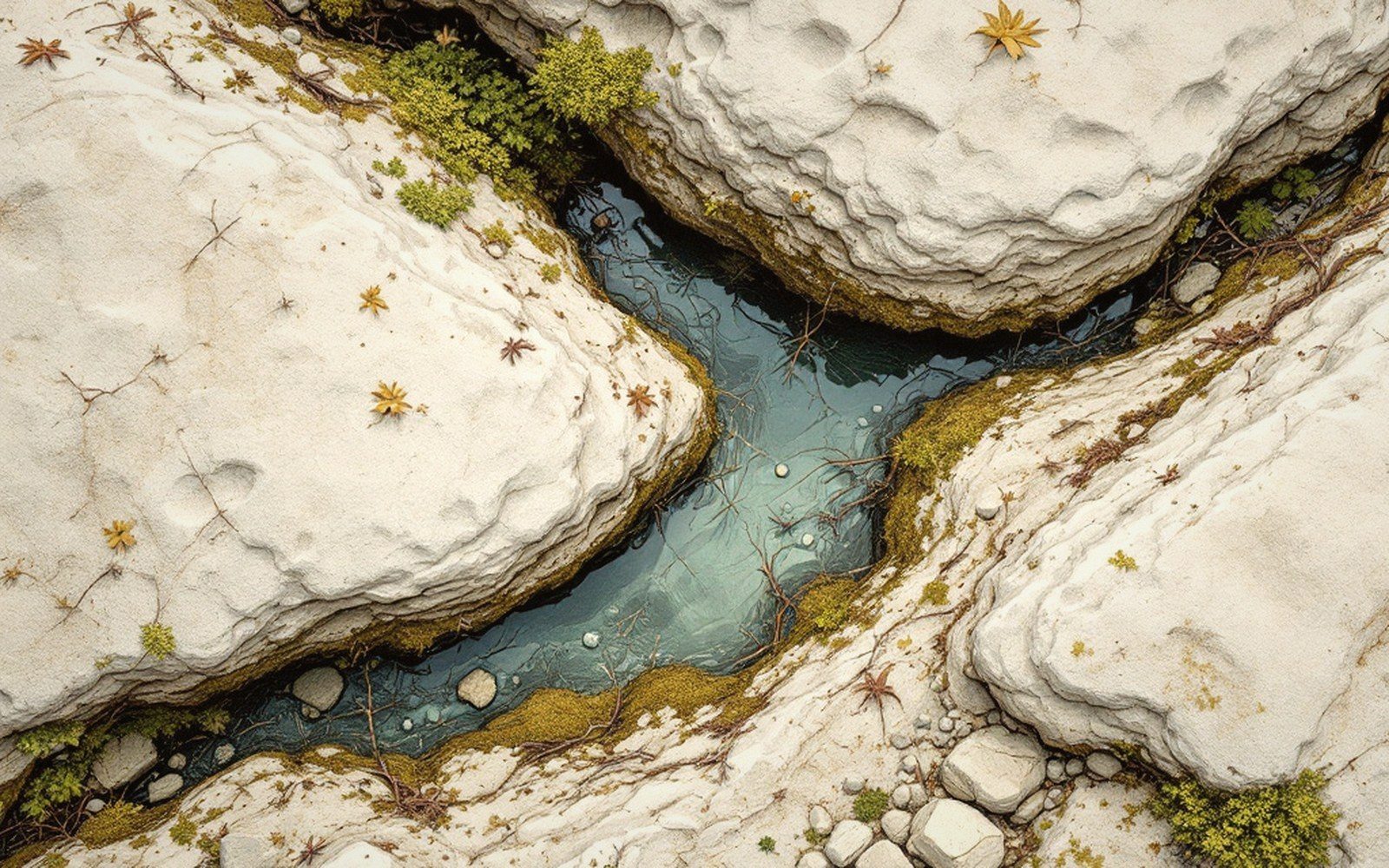
When the spring rebuilds what the river dissolved
Limestone dissolves. That is the whole premise of karst — rainwater picks up carbon dioxide from soil and air, becomes weakly acidic, and works on calcium carbonate until the rock gives way. But dissolution is not the end of the story. The same chemistry runs in reverse, and where it does, the landscape builds itself back up.
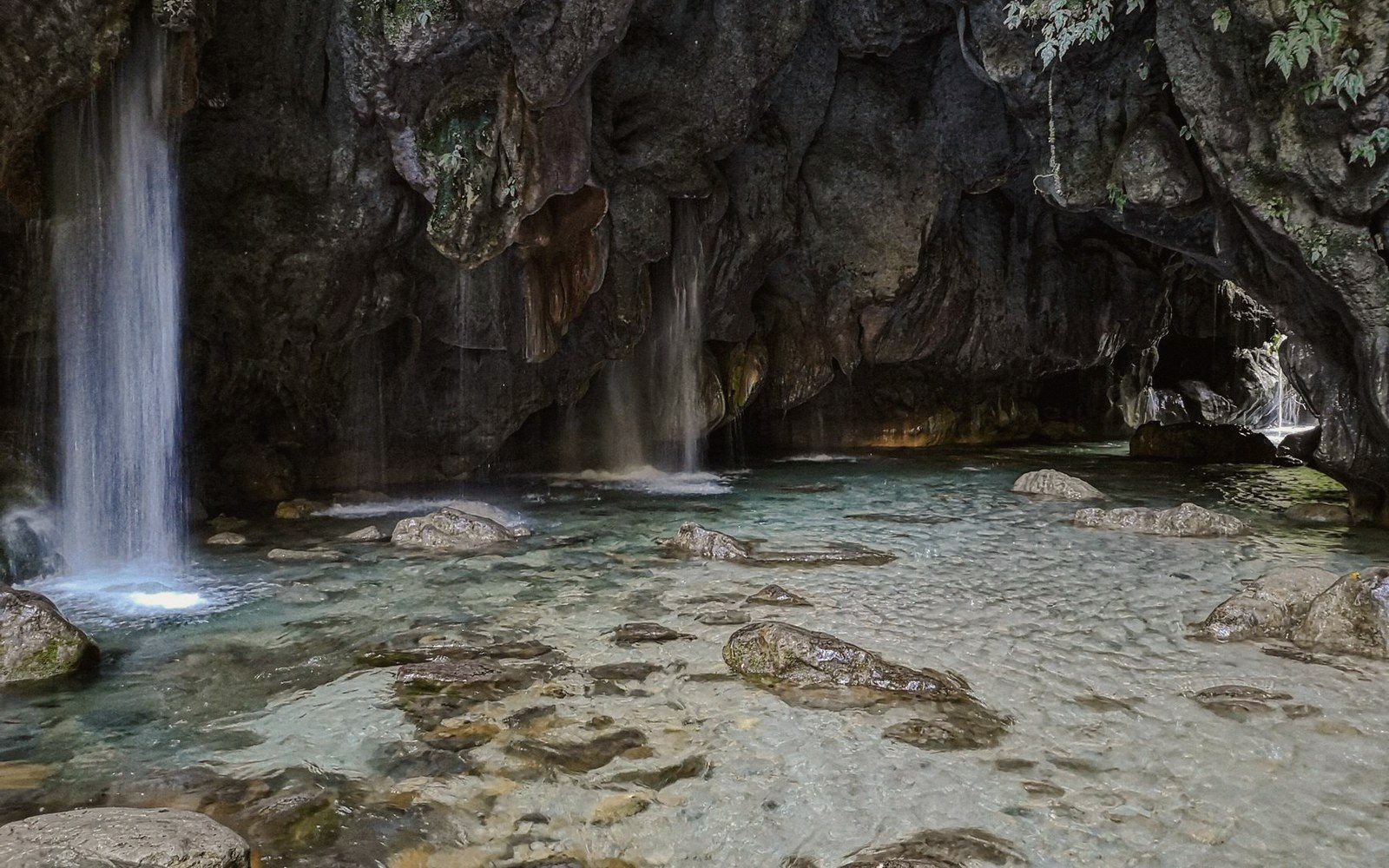
The process is straightforward. Groundwater moving through the rock carries dissolved calcium bicarbonate in solution. When that water emerges at a spring, it loses carbon dioxide to the open air. As the CO₂ escapes, the water can no longer hold as much calcium in solution, and calcium carbonate precipitates out. It settles on whatever surface is available — a twig, a leaf skeleton, a fallen branch, the edge of a pool — and the deposit is called tufa. Given time, tufa thickens into pale, spongy masses of rock, porous with the ghost-shapes of the organic material it encased.
Field notes · The chemistry in brief
- Rainwater + CO₂ → carbonic acid → dissolves limestone → calcium bicarbonate in solution
- Spring water degasses CO₂ → calcium carbonate precipitates → tufa forms
- Reverse of dissolution, same compound, same location over geological time
The word "tufa" requires a distinction. It is not the same as travertine, though the two terms are sometimes confused. Travertine forms from hot or geothermally active waters and is denser, more crystalline; tufa is a cool-water, near-surface deposit, the specific product of a karst spring meeting open air.
At the mouths of the reculées that cut back into the Jura plateau, tufa formation is often conspicuous. Water emerging from the cirque head is typically saturated with calcium — it has travelled through limestone long enough to reach equilibrium with the rock. The moment it tumbles down a cascade or spreads across a weir, degassing accelerates, and precipitation follows fast enough to be observed across a season. Waterfalls here sometimes build their own lips, adding millimetres of tufa each year until the lip extends outward as a natural dam. Behind such dams, shallow tufa lakes can form, stepped one above another down a valley floor.
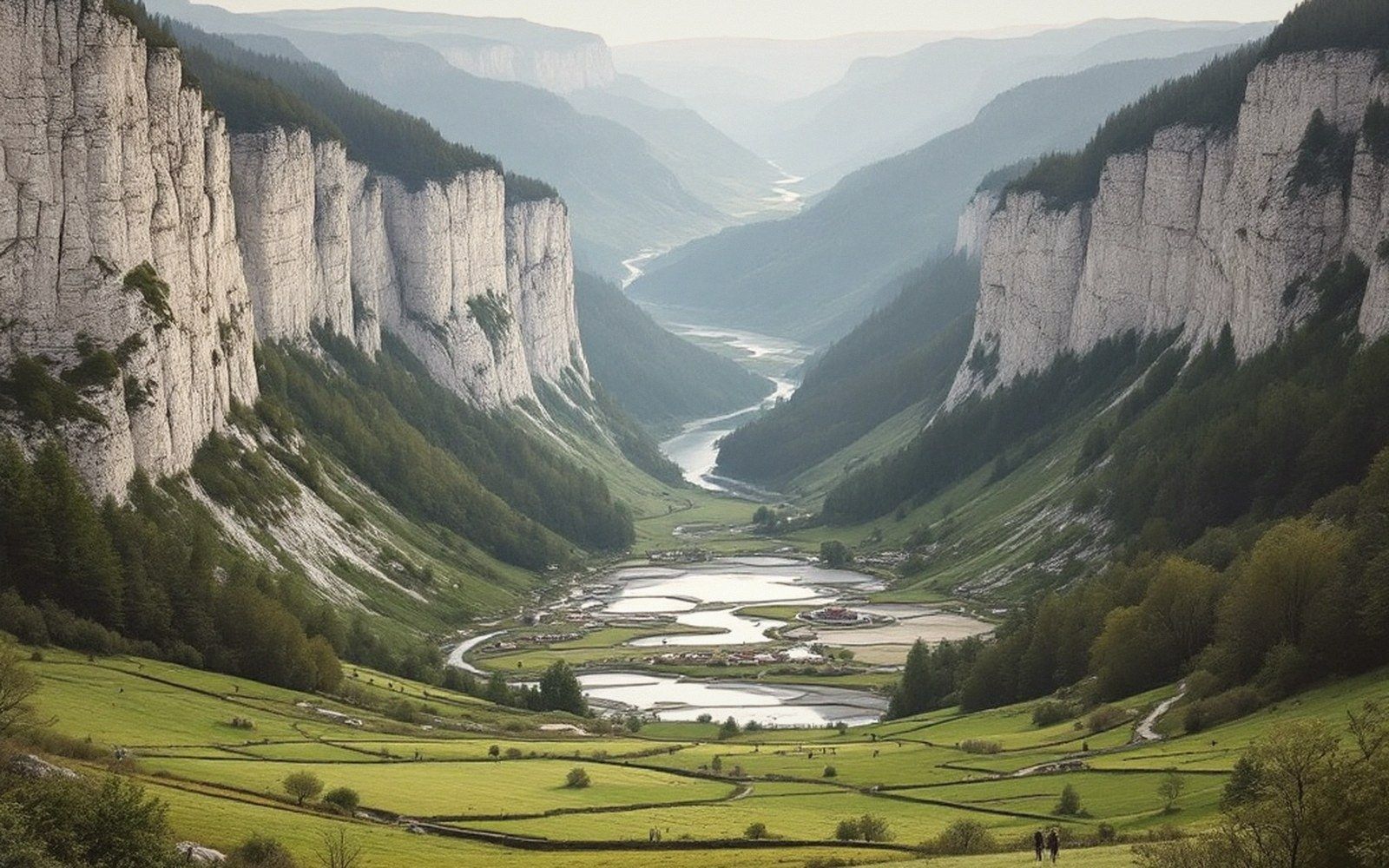
The rate of deposition depends on temperature, flow rate and the turbulence that drives CO₂ out. Fast, aerated water over a sunny cascade deposits tufa quickly. Slow seepage through shade deposits it slowly or not at all. Seasonal variation is real: summer warmth and plant metabolism both lower the CO₂ level in the water, favouring deposition; winter slows it.
Field notes · Vocabulary worth separating
- Tufaporous, pale limestone deposit from cool karst springs; formed by CO₂ loss at the surface
- Travertinedenser, more crystalline carbonate rock from hot or geothermal waters; a different process
- Calcium bicarbonatethe soluble form calcium takes while in transit through the rock
For the geologist, a tufa deposit is a record. Its internal structure — laminated, porous, preserving plant fossils in three dimensions — can be dated and read for past climate. Pollen trapped inside a tufa mass tells what grew nearby when that layer was laid down. The spring that dissolved the plateau is also, stone by patient stone, rebuilding it.
Keep following the water